The Power of Illusion

ASC 606.  While I think it can be a very useful tool in some situations, like with condominium and homeowner associations, I am not convinced that it will help a reader, an investor, anywhere else.  That is because it is almost uniformly built on the concept of management choice – which sadly can lead to poor decisions that ultimately hurt investors.

In a perfect world, I think the concept of ASC 606 is inspiring.  Finally, a reader can see what has been committed to and what prices will end up being paid.  What a great way to predict a company’s ability to generate future cash flows.  But that isn’t what is going to happen. I have seen enough at my end of the spectrum to know that anytime subjective measures are involved, those impacted want the measures skewed in their direction.  And something like ASC 606, which almost completely makes determining revenues subjective, simply is going to take this to a new level.

This reminds me of an attest engagement on a contractor.  The contractor stated that they had a maintenance contract which runs for 12 months with options to extend an additional 12 months and 6 months.  No problem.  We though.  We asked for the contract, the controller hemmed and hawed.  Why?  She put the information into the disclosure so there must be a basis for its inclusion.

Apparently not.  It seems that the customer is not so thrilled and has expressed that they won’t extend the contract.  But there is a catch.

The customer is also the ultimate customer on several other contracts.  It seems that the customer accounts for about 60% of the revenues for this company and when this contract goes, there is about a 99.8% chance that the other contracts are not renewed and new contracts won’t be awarded.

This all came to a head when we questioned the fade, or loss of gross profit, over contracts.  Long-term contracts are handled on the guesstimate method.  We use the “objective” measure of actual cost incurred in relationship to the guess of total estimated costs.  The total estimated cost is management’s choice, its illusion, which drives not only gross profit recognized but also the percentage of completion.

We identified a problem.  The fade, or the loss of gross profit over time, on contracts was starting to become noticeable.  The graph shows what we noticed:
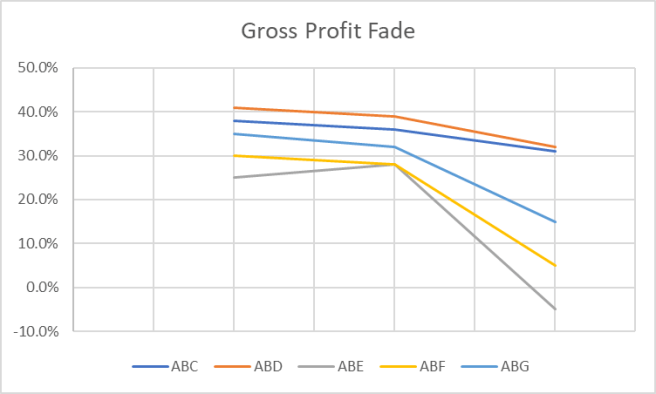
fade analysis

The gross profit percentage ends up remarkably lower over time.  There is really only one reason for this, the inability to estimate accurately.  Notice that all fade is in excess of 5 basis points, the smallest fade being 7 points on project ABC.  If this were a $10,000 project, that wouldn’t be a big issue but it is their second largest contract.  And worse, you can see that on one job they estimated an increase in gross profit in year two only to have it plunge to a net contract loss of 5%.
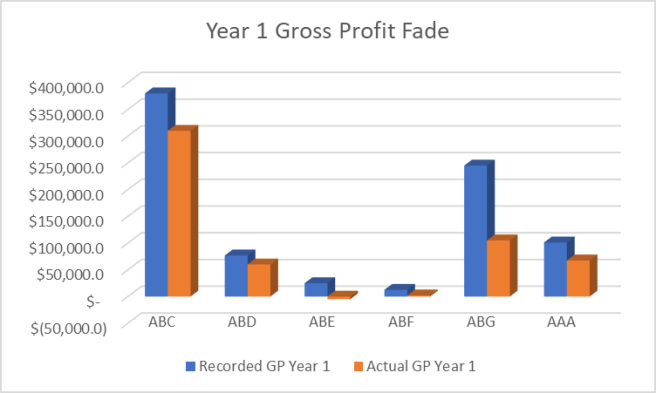
GP Fade

I know I know, the point.

The problem is that they estimated their new contract, the one likely not to get extended at 45% gross profit.  The trend though, is clear: Gross profit fades lower consistently over time.  The trend indicates to us that the project will end up at 30% overall.  The project AAA is recorded at 5% complete which means the company has recorded over $100K of gross profit.  The trend says that, at best, they have earned $67K.

But wait, there’s more.

Since the original estimated cost in year one is too low, this changes the percentage of completion.  Not a lot, but enough.  The true fade, after revising the percentage of completion is

true fade.png

Huge.  So huge, in fact, that it can’t be ignored.  It totals out to about $375K of gross profit incorrectly recognized in earlier years.

Of course, our concern is not really those older contracts, it is the new one, the one which is likely not to be extended.  It is our concern that current gross profit is overstated by about $50K AND it is likely that this contract won’t be reupped and that there will be no future contracts with this customer.

With the loss of this customer, revenues will drop 50%.  Given the fade problem from poor estimates, the company has not had the gross profit it envisioned on these projects which has forced it to borrow heavily to meet its operating needs during the end phase of these projects.  The borrowing, by the way, is from both the bank and the new projects with higher initial gross profit that will ultimately fade away.

Since we are independent CPA’s attesting to the financial statements, we are held to the standard that we think the company in question can continue as a going concern for at least one year from the date of our report.  We ran several different scenarios, none of which succeed in changing the trajectory.

I would like to say there was a happy ending.  I guess in a way there was.  Management, the sole owner, decided to terminate our engagement.  The next year, the owner filed for bankruptcy.  The bank never got is independent accountants’ report by the way.  They didn’t call the loan and ended up with over a $500K loss due to the reorganization.

It is tempting to believe that management wants accuracy and objectivity in its reports.  But as with estimated costs to complete, ASC 606 is open to management’s very subjective and capitalistic approach.  Management is responsible for

  • determining what makes up a contract with a customer
  • selecting at least one (and possibly only one) performance obligation
  • Allocating the contract price over the performance obligations
  • Determining when the performance obligation is complete so that the price can be recognized

These all have similar requirements – management’s ability to use good judgment.  And much like with contract estimates under old GAAP, it will be well-nigh impossible for an independent CPA to challenge management’s assertions, until it is too late.
 

Alignment

Growing a business can be challenging.  It doesn’t help that there are lots of books and internet articles explaining how so-and-so did it with no investment and no effort.  Those stories might be inspiring, but they don’t always tell you the whole story.  What those stories aren’t telling you might cause you to chase a plan for longer than you normally would.  No small part of that has to do with alignment.

Alignment in business is all about making sure your marketing, your message and ultimately your assets all support your core business.  A great example of this came from a company I was assisting as an outsourced controller.  At a strategic retreat, the leadership decided it wanted to start going after larger commercial construction projects.  This was a great idea but it meant more than just saying “here we are.”

First we had to deal with the fact that most manufacturers did not adequately plan for their liquids and gas piping.  And yet, in order to do the job well, the piping needed to be planned.  Client’s did not have specialists on staff to handle this nor did most architectural firms.  Don’t get me wrong, they had a good idea of how it needed to be, but some things are highly specialized.  To be successful the Company needed to invest in an engineering team.

The engineering team needed the right tools.  Auto-cad, plotter and a quiet place to do the design work.  Not to mention a large space where the team could meet with clients to review the plans and requirements.

The company then needed to get the message out to the construction community.  The company’s sales team needed to be armed with information to help clients in their selection process.  We had to successfully educate them that lowest bid is not always the most appropriate bid.

Finally, the company needed to address its pricing model.  There was an obvious disconnect that was hamstringing the growth and adoption of the new service.  The company was moving from a repair and maintenance service to a construction service

but management was still using their service rate to try and price the construction.

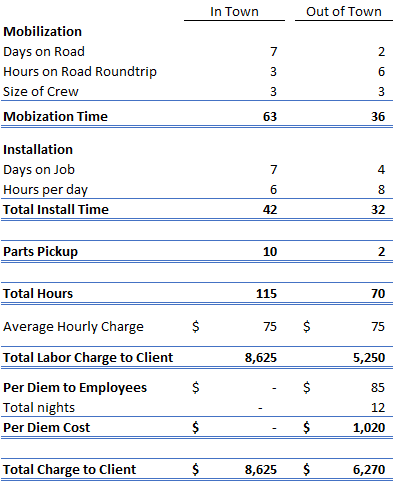
rate analysis

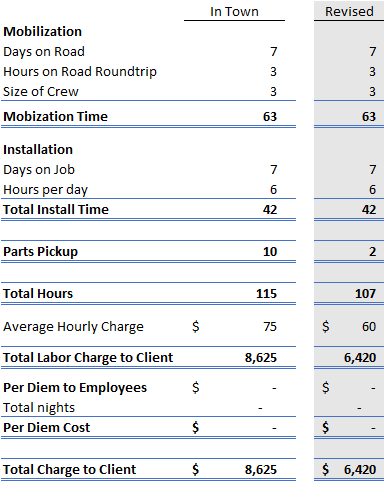
The company was pricing local jobs about 20% higher than out of town work.  This was driven by two issues – first daily mobilization from an office no nearer than 15 miles from the nearest likely construction site and second applying the service rate to the total time.  The service rate worked well for service – it required some technical skill to diagnose a problem with a gas distribution system and the client expected to pay for the “emergency” nature of the call-out which included travel time to get to the job.

This doesn’t always apply in construction.  And because of this, the company was not completely aligned.  Local jobs were being lost and the company had work coming out of its ears hundreds of miles away.  The crews were tired of being away all of the time and it was harder to manage if things went sideways at the jobsite.

So, the sales manager, the engineering manager and I sat down and figured out how to get aligned.  The estimate was redesigned to charge a lower rate for mobilization in town.  The engineer generated a bill of materials for every job – one problem was that local jobs were not getting the same supporting documents since it didn’t seem like a problem to run around town and pick up parts when the crew was local – all of which allowed the company to still make a substantial profit on jobs, since the company was now able to land local contracts which reduced wear and tear on vehicles and employees.

rate analysis rev 1

As your company leader, always make sure your entire business is aligned.  The greatest service in the world won’t make you a dime if customers don’t agree with the pricing.

The power of analysis

Do you have a checklist for your month end closing process?  Have you added running analytical testing to your checklist?

Managing multiple association accounting systems does not leave a lot of time to thoroughly review everything, which is, of course, why we created our checklist in the first place.  I can determine what has been completed and by whom and then spot check their work.  It also helps that we have solid systems to fully vet transactions as they are incurred and which work hard to detect and prevent fraud – but still, the goal is to provide full information for the month and year-to-date so we struggle with determining what might be missing.

First, look at some relationships between your balance sheet and your statement of operations.  Certain accounts have very comfortable relationships – think inventory and cost of goods sold while others may be more tenuous.  Also, keep in mind that the purpose is to help you determine if the statements appear reasonable; so don’t overdo the number of calculations.

Some key ratios you should consider running at month end to help you pinpoint potential problems:

Days in Accounts Receivable

This will give you a sense of potential collection problems without having to dig into the aging: Take your monthly revenue and divide by 30, this is daily sales.  Then divide this amount into your accounts receivable balance.  Now, the two most important questions you should ask yourself: Is it over 30 days?  Is it higher than prior periods?  If it is more than 30 days, you have sales from prior months which have still not been collected and if it is increasing, then you have many sales which are not being collected and you might need to consider increasing your allowance for potential bad debt.

Days in Inventory

This will give a good idea if inventory is being handled well without worrying about a potential physical count of inventory.  Take your cost of goods sold and divide by 30, which is the daily cost of sales and then divide this amount into inventory.  Is the pattern consistent with prior months?  Did you see an unexplained change that skewed the results well beyond prior months?  A large increase could indicate that some CoGS were not adjusted properly or that potentially you have inventory which is not turning over, potentially indicating obsolescence.

Sales Growth Rate to change in A/R

Comparing the growth in sales to the change in accounts receivable can also provide an indication of deteriorating a/r quality.  If your sales increased by 5% from the prior months but your accounts receivable increased by 25%, it could indicate that collection problems might exist.

Gross Profit Percentage Month Over Month

If your company sells products, this could help you address a change in your business or in customer demand – either of which could indicate other potential problems.  You will want to map out your gross profit percentage – which is revenues less cost of goods sold and divided by revenues – for each month over the past few years.  First, compare it to the past few months, is the trend consistent?  Then compare it to the same month in prior years.  If you are trending downwards both over time and in comparison to the same period in prior years, this could indicate possible issues with the costs of materials or production issues, both of which can have long-term impacts to your business.

Labor Costs to Revenues

One area where a small business can be caught off-guard is in labor costs.  Unplanned overtime can be especially painful so always watch to ensure that overtime is planned and paid for, either in revenue premiums or in additional sales.  If labor is consistently increasing during months of slow or no sales growth, perhaps your overtime policy needs to be re-evaluated to ensure that it is not out of control.graph hr rev to ave

In this example, taken from a client who was experiencing reduced profits, we were able to identify the driver was in fact over 1,400 overtime hours.  There were two primary drivers of this, first was that department managers did not actively plan work for the week, leaving things to be completed on Wednesday and Thursday so they could be shipped on Friday.  Since there was always a lot of work to complete, the teams were working 2-3 extra hours on those two days, even if Monday and Tuesday had the teams with substantial idle time.  Second was that there was no policy to require the manage to authorize the use of overtime in advance.

Analytics can help you understand how your business operates.  It can point out areas where additional effort might be called for and also help management isolate and test potential issues to see if a change can help improve performance.


Supplementing Your Accounting System

At a meeting last week, I was asked what software we recommend for accounting.  The owners runs a small business, fewer than 10 employees and sales in about a dozen states.  They are currently using QuickBooks but it doesn’t track everything they want easily, especially their inventory which is often stored in multiple locations.

I suggested keeping QB but supplementing it.  “With Excel?” one of the owners asked.  No, I replied, with Access.

I am a big fan of doing work, especially accounting work, in database systems.  This isn’t to say that spreadsheet’s don’t have a place, they do, but in a lot of cases, a well structured database enables a company to run complementary systems with minimal investment or complexity.

For example, we use Access to manage the complex owner payments for a condominium project we are managing.  The system automatically generated the assessments to each owner and we can receive payment and split the payment up much easier than in Excel.  Plus, we created a series of sub-tables which allow us to set up and create daily ACH files to upload to the processing system.  In the 3 months we have been using the Access system, we have cut our time to record and reconcile deposits about 90%.  And we know so much more about who, when and how owners pay their assessments than you could ever get out of Excel or even QB.

We set up the deposit form with a series of check boxes which allow us to manage payments to the special assessments – and allocate interest to the payments – as well as flagging us to record the deposit in QB.  Every week, I can run a specific query which searches the deposits table for unrecorded deposits and create a matrix table showing me how much to record as a deposit in QB to each owner receivable GL account as well as the amounts which were deposited to the various bank accounts.

We can track significant detail for each owner, including multiple emails and phone numbers as well as setting which method the owner prefers their information.  And, because we know how important it is to know when one owner’s responsibility ends and another’s begins, we created a specific process to track unit sales and split the transaction up to help both the buyer and seller know when and how much they owe at time of closing.

And the best part is, when we need something kicked out to Excel, we can create a routine which gathers the information in a query and automatically creates an Excel workbook.  Doug used this feature to help with the budgeting process to ensure that the allocation percentages were accurate without having to rekey data for each of the various scenarios.  And, once the budget was approved, we could reimport the Excel file to create the new year’s assessment charges for the Owners statements.

Excel is great.  We use it extensively, especially for financial statements and analysis.  But when you need to control data entry and you want to ensure only approved data are used, I strongly suggest you consider Access, or any other database application you like, as it is superior than Excel for multi-user and data management.